Your ORC certificate is the anchor. Every delta is computed from there.
Now with R16: stability (the boat’s righting behavior — rated on the certificate, then computed by the R16 stability layer for each sailing state) and heel from the certificate alone. Every answer
graded. No answer guessed.
The current physics release — R16 — carries a boat-integrated DSYHS hull
backbone (52 Delft-series reference geometries, IGES-derived, matched to your
certificate), then resolves appendage resistance, heel influence, sideforce/leeway,
rudder interaction, and approved wave resistance where the boat data supports
it. Drive that doesn’t survive the full force balance (the solve that balances the aero and hydro forces at one wind condition — a SailEdge computation, never an ORC rating) doesn’t reach the
published speed.
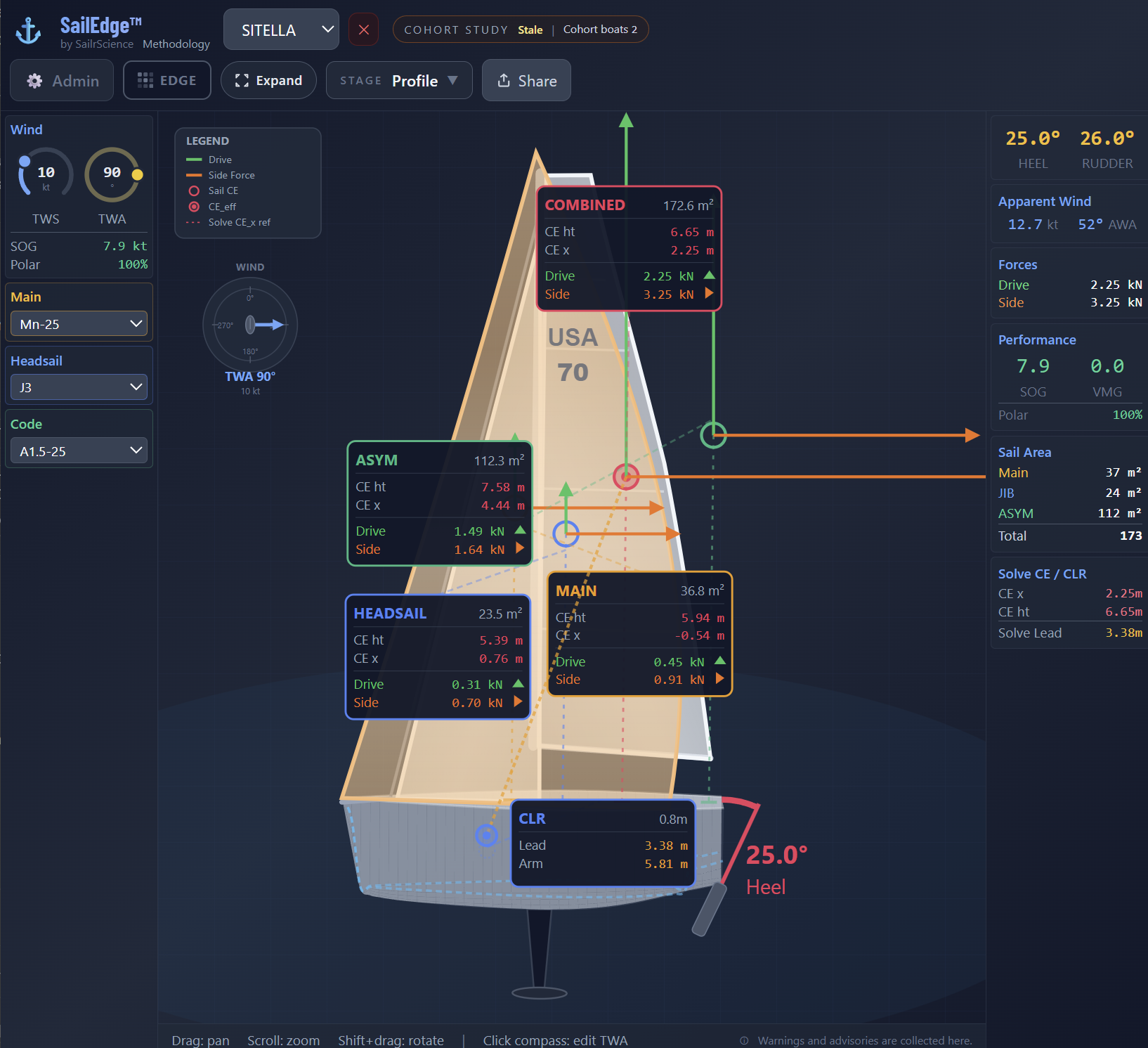
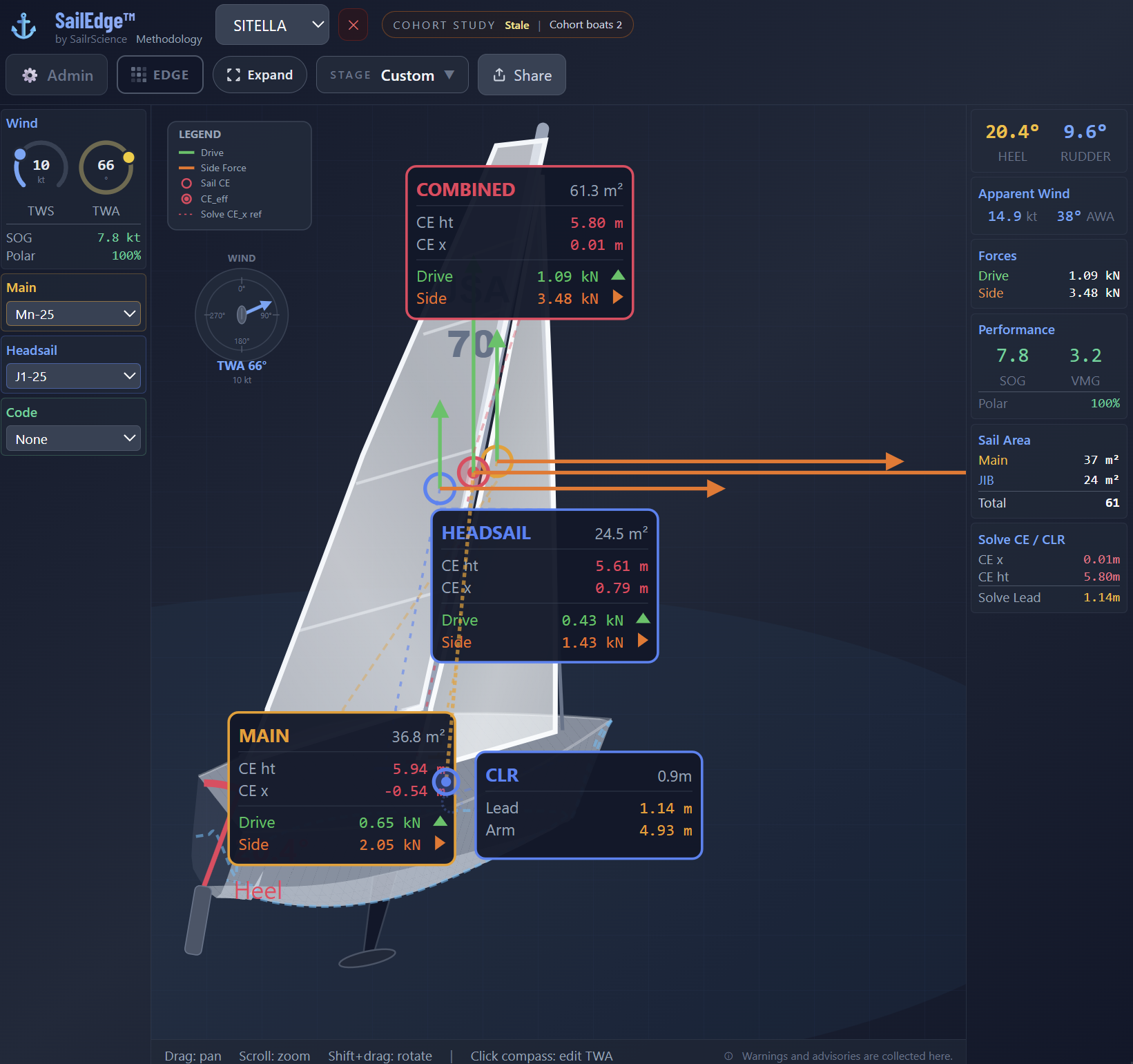
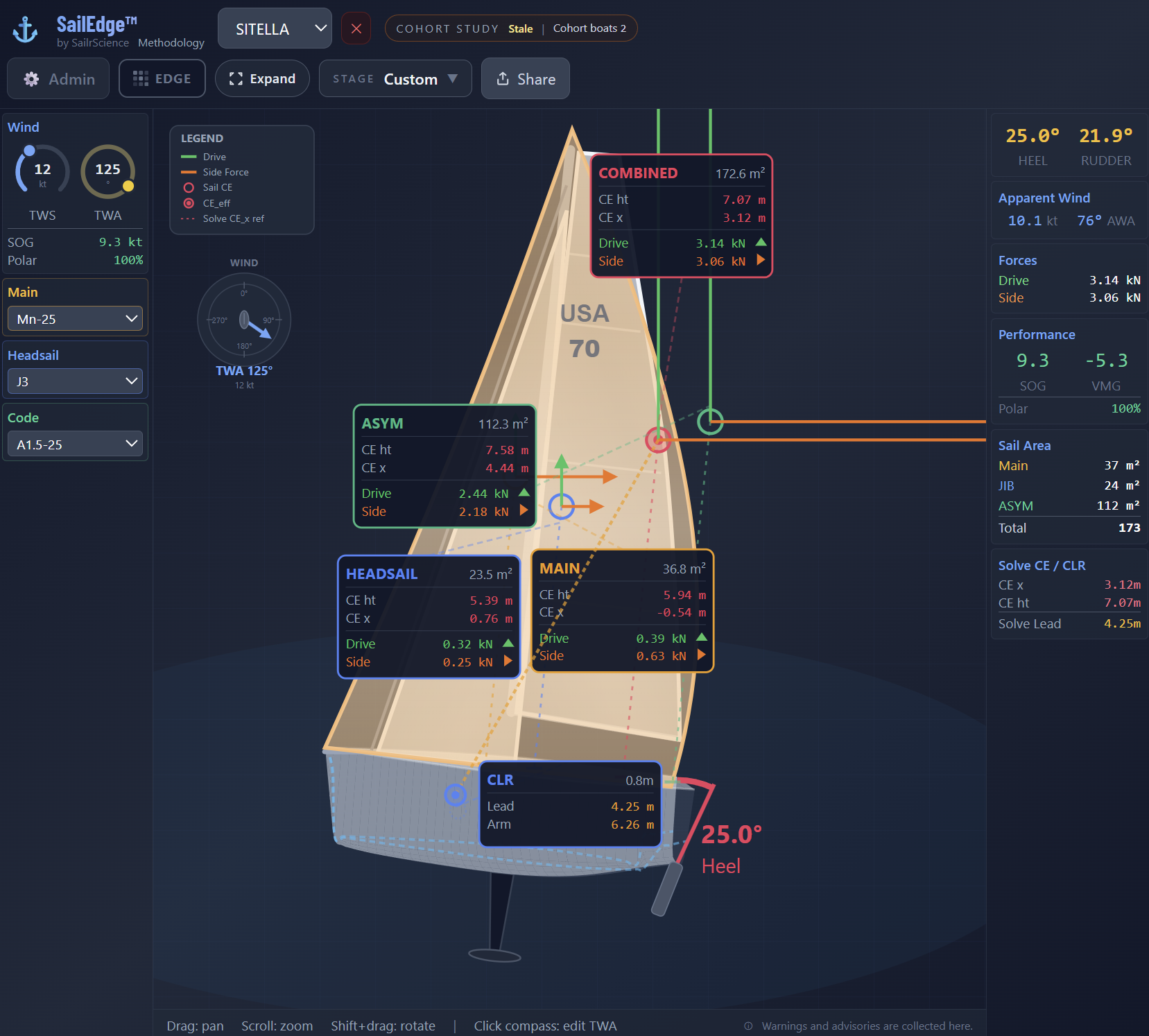
CE (where the aerodynamic force effectively acts — modeled per sail from its planform geometry, trim state and wind condition) is computed from actual sail planform geometry — not rig ratios.
Each sail carries its own force decomposition: drive, side force, heel
moment. Blanketing is real — the model accounts for it. Fly two sails
and the engine force-weights them into combined balance.
The 3D view renders it live. Force vectors. CE markers. CLR (the Center of Lateral Resistance — the underwater pivot point where hydrodynamic side forces act on the hull and keel). Heel.
A physics instrument, not a picture of a boat.
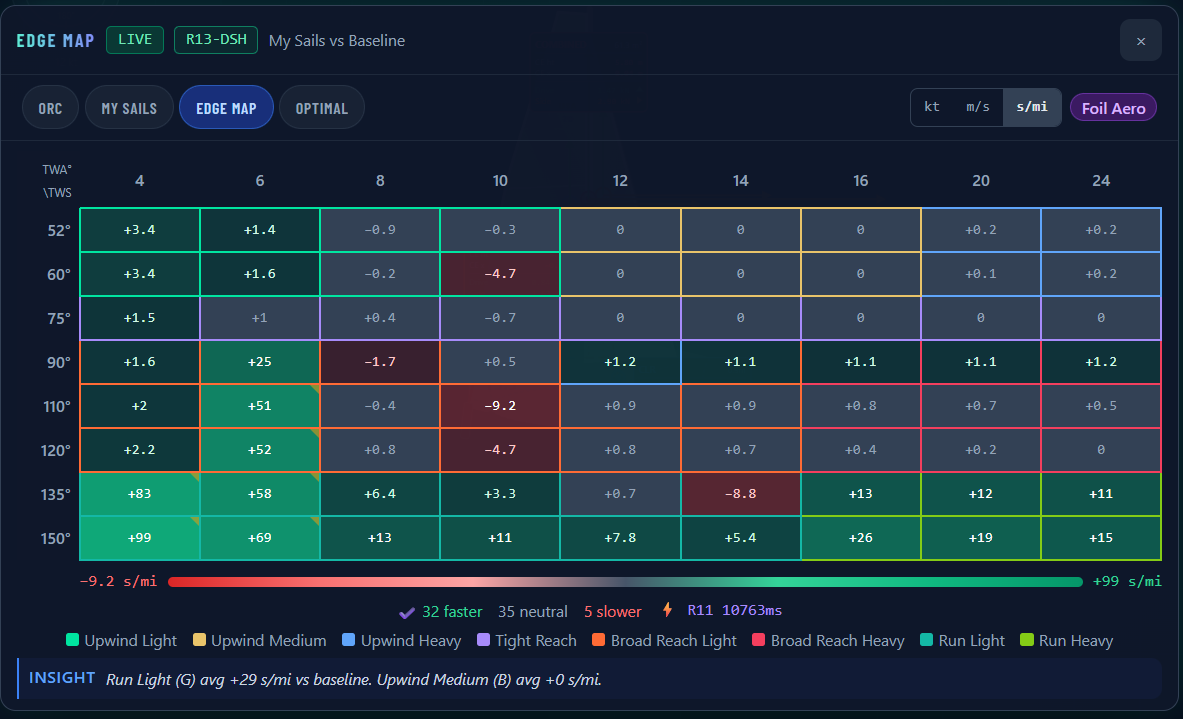
The Edge Map (the performance delta grid — every sail measured against your boat’s ORC polar at every wind speed and angle) distills it into one grid. Green where you’re faster.
Red where you’re not. Tap a cell (one intersection of the wind matrix — one true wind angle, one true wind speed, one sail combination evaluated against the ORC polar) and the panel carries both per-sail
attribution and whole-boat outcome, so a gain in drive can be weighed against
heel, drag, wave lane status, and balance shift.
Built on ORC certificate data. Not affiliated with ORC. Not a rating predictor.