Home›
Racers
›
Digital Twin
Your boat.
Your sails.
In your pocket.
Upload your ORC certificate and your SailEdge™ by SailrScience Digital Twin builds itself —
certified dimensions, rig geometry, rated sail inventory, and a live performance model
built on the R16 physics release with its DSYHS calm-water backbone and bounded
follow-on lanes. A living model you can take to the dock. In 2025, ORC issued over 14,000 certificates — the most in its history. Each one holds the data for a living digital twin. Yours is next.
Explore Your Edge
See the Edge Map →
From Certificate to Digital Twin
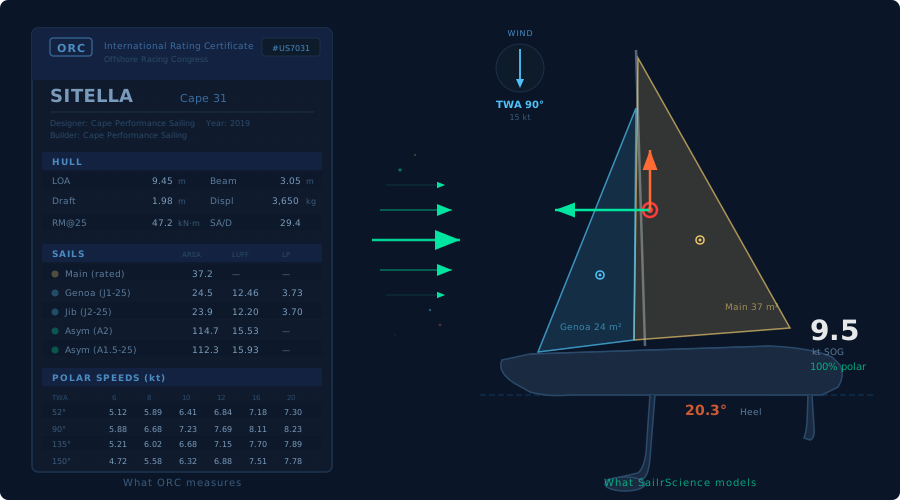
Your Digital Twin is your boat, computed. The certificate anchors your dimensions,
rig geometry, sail inventory, rated stability (the boat’s righting behavior — rated on the certificate, then computed by the R16 stability layer for each sailing state), and certified polar data —
preserved exactly as issued, never altered. The hull is carried by the best-fitting
reference profile from the hull library — 52 Delft Systematic Series reference
geometries, IGES-derived (shown, and yours to change) — and the live boat
response runs on the same R16 physics.
The certificate is immutable. What you explore, tune, and compare is layered on top of it.
What certificate are you holding?
SailEdge™ by SailrScience builds your Digital Twin from the data your certificate
actually carries — so what we can build depends on which certificate you hold.
Certificate-measured, certificate-declared, and computed values carry different labels
in your twin — you always know which one you’re reading.
What is inside your Digital Twin
Not a spec sheet. A living model.
Every SSDT™ is built from your actual documents — ORC certificate,
owner’s manual, sail cutsheets. The result is a calibrated model containing
over 200 parameters that drives 850,000+ physics evaluations (one full aero and hydro force-balance solve at one point of the wind envelope) across every
wind condition and sail configuration your boat can fly.
200+
Hull & Rig Parameters
LOA, LWL, beam, draft, displacement, ballast, I/J/P/E rig geometry — all extracted from your documents.
72
ORC Polar Cells
Anchor polars from your certificate at 9 true wind speeds and 8 angles — the certified baseline for your hull.
8+
Sail Types
Main, Genoa, Jib, Staysail, Code 0, A2 Asymmetric, HR55 and HR75 heavy reachers. Full spectrum.
RM
Righting Moment Curve
Your boat’s stability fingerprint — anchored to the certificate’s rated righting moment and constructed across the heel range, source labeled. Drives heel equilibrium at every point of sail.
I/J/P/E
Rig Geometry
Precise foretriangle and mainsail dimensions. Determines sail area limits, CE positions, and sheeting angles.
850K+
Physics Evaluations
Speed, heel, CE position, per-sail force decomposition, and whole-boat outcome — drive, side force, drag, rudder correction, and balance state computed for each sail combination. Sail interaction included: when the main blankets the headsail, the model accounts for it. When your sailmaker provides material and shape data, the model adjusts — membrane sails, squaretop planforms, and high-roach mains are credited for what they actually deliver, not treated as generic foils.
Every result on the map is the output of a complete force-balance solve. See what gets computed →
What you do with it
Plan. Compare. Decide.
Your Digital Twin is not something you look at once. It is a planning companion
you return to whenever you are thinking about your boat — at home, at the
marina, or sitting across from your sailmaker.
Your genoa is eight seasons old and the quote is on the table. Load the boat you
have, add the sail you’re offered, and watch the two argue across every wind
condition — before you sign anything.
📱
Your Boat in Your Pocket
All your boat data — certified dimensions, rig geometry, full sail plan —
unified in one interactive 3D model. Run what-if scenarios across wind
conditions. Identify coverage gaps. Build a prioritized acquisition plan.
“Your entire sail plan — modeled, measured, and in your pocket.”
🏁
Race Prep
Variable forecast? Your twin gives you target speeds by true wind angle
for each sail configuration. Know your crossover points. Know when to call
the sail change before the start.
“Know your targets before the start.”
🔬
Build Your Intuition
See how forces act on your sails — independently, per sail. Watch CE move as wind builds. Understand
why depowering works, why a smaller jib can be faster, and how sail interaction
changes the picture at deep angles. The model shows where added area helps
and where it just adds heel.
“See the physics. Build the intuition.”
Your sailmaker’s new favorite client. Show up measured, specific, and ready.
And if your loft is a partner, they send the sail as a loadable asset — the
proposed sail appears in your inventory before the invoice does.
See how sailmakers use your Digital Twin →
Why it matters
Not a profile. A twin.
A boat profile gives you…
- Static specifications copied from a brochure
- Generic data shared across all boats of the same model
- No performance predictions
- No sail-specific analysis
- No scenario modeling
Your Digital Twin gives you…
- Parameters extracted from YOUR documents
- Performance tuned to YOUR specific hull and rig
- 850,000+ physics evaluations across every condition
- Per-sail CE, force balance, and heel analysis
- What-if scenarios for sails you do not own yet
The certificate is the contract. Everything above it is where your edge lives.
Crew weight is now part of the twin — change it and the entire force balance recomputes.
The hull is carried by the best-fitting Delft Series reference — shown for
review, yours to change as a declared scenario — and the stability behavior
is tunable per hull family with a Delft-style RM profile.
What it delivers
The twin works for you three ways.
Your Edge Map
Your twin feeds the Edge Map (the performance delta grid — every sail measured against your boat’s ORC polar at every wind speed and angle) — green where you’re faster, red where
you’re slower. Add a sail you’re considering, tweak what you have,
and measure the delta before you commit. Tap a cell and the same twin explains
it through per-sail attribution, whole-boat outcome, and confidence context. (the model’s own statement of how sure a cell is — an amber cell names the boundary that limits it)
See your Edge Map →
Boat Certificate
A companion to your ORC cert covering everything it doesn’t: per-sail
performance deltas, coverage gaps, CE positions, whole-boat outcome,
and recommended configurations. One page. Portable. Bring it to the loft.
Your Data
Built from documents you provide. Not shared with other users, not sold
to third parties, and never used for model training. The physics, bounded
partner tuning surfaces, and protected implementation all stay server-side.
The twin is yours.
Take It With You
Export your Digital Twin as a Boat JSON artifact. Your sailmaker loads it
directly — hull parameters, rig geometry, sail inventory, and certified
baseline already structured and ready. No transcription. No back-and-forth
on specs. Protected partner tuning stays in governed partner workflows, not in the browser.
See the loft workflow →
Digitally generated from one document. Your ORC certificate.
See how the pipeline works →
Preparing for the sail loft? →