Declared · Computed · Disclosed

Your platform. Calibrated.

Boat Tuning in SailEdge™ by SailrScience — Delft-style stability, direct geometry editing, guided calibration, portable.

Explore Your Edge NA Workflow →

Stability

Tune the RM curve for form vs ballast.

Geometry

Edit cross sections directly.

Hydro

Calibrate the hydro lanes.

Save

Portable NA profile and hull-section artifacts.


Righting Moment

Tune the stability curve for your hull family.

A stability profile built from GZ curve analysis — how much of the righting moment comes from hull form vs ballast, and how it evolves with heel.

Select a Delft hull on the Boat tab and the profile seeds automatically with the behavior your hull family predicts. Adjust for your specific hull.

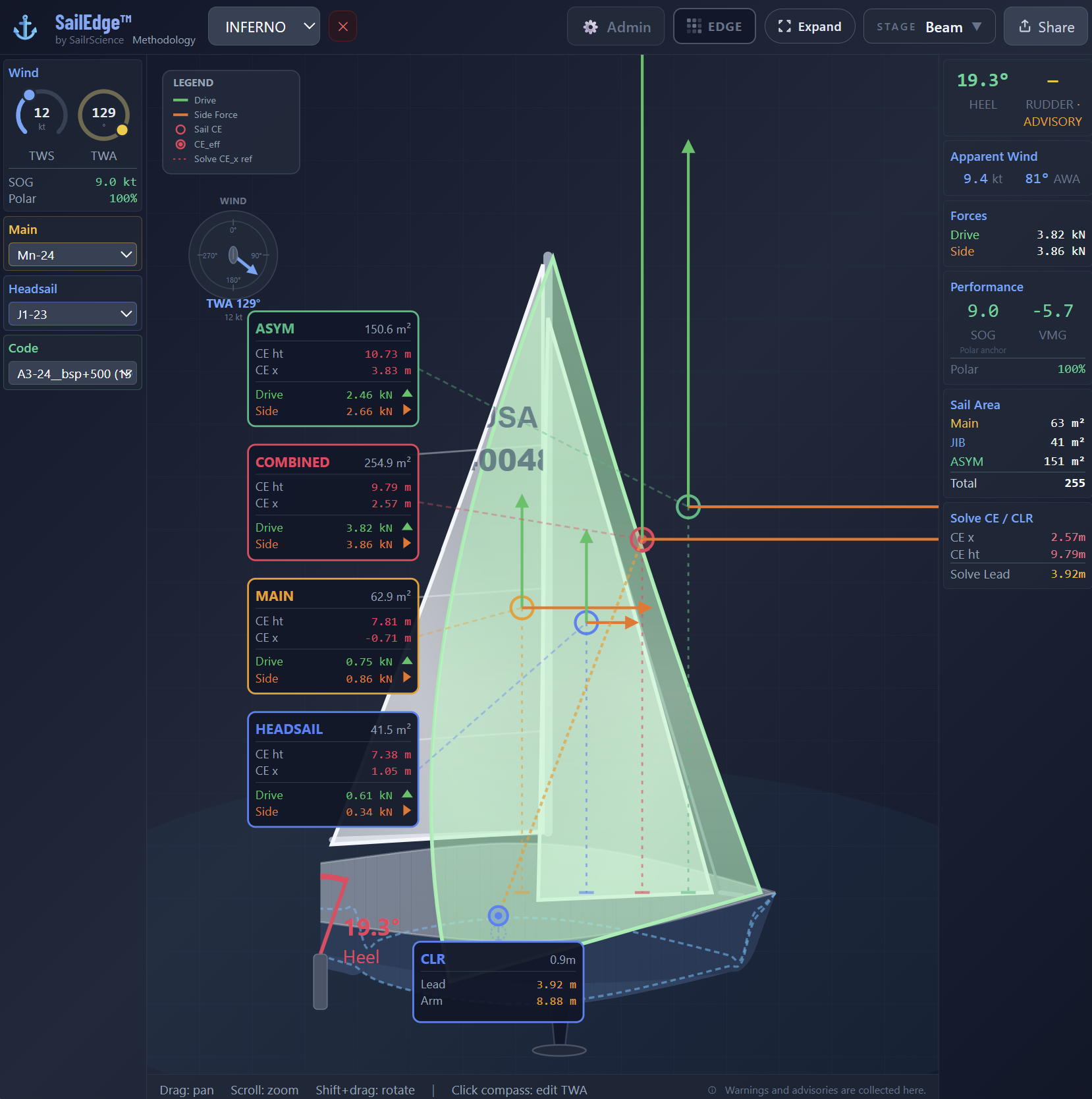
Righting moment is the third force in the balance story — see how it meets CE and CLR in the three-force system.


Hull Geometry

Edit the section you can see.

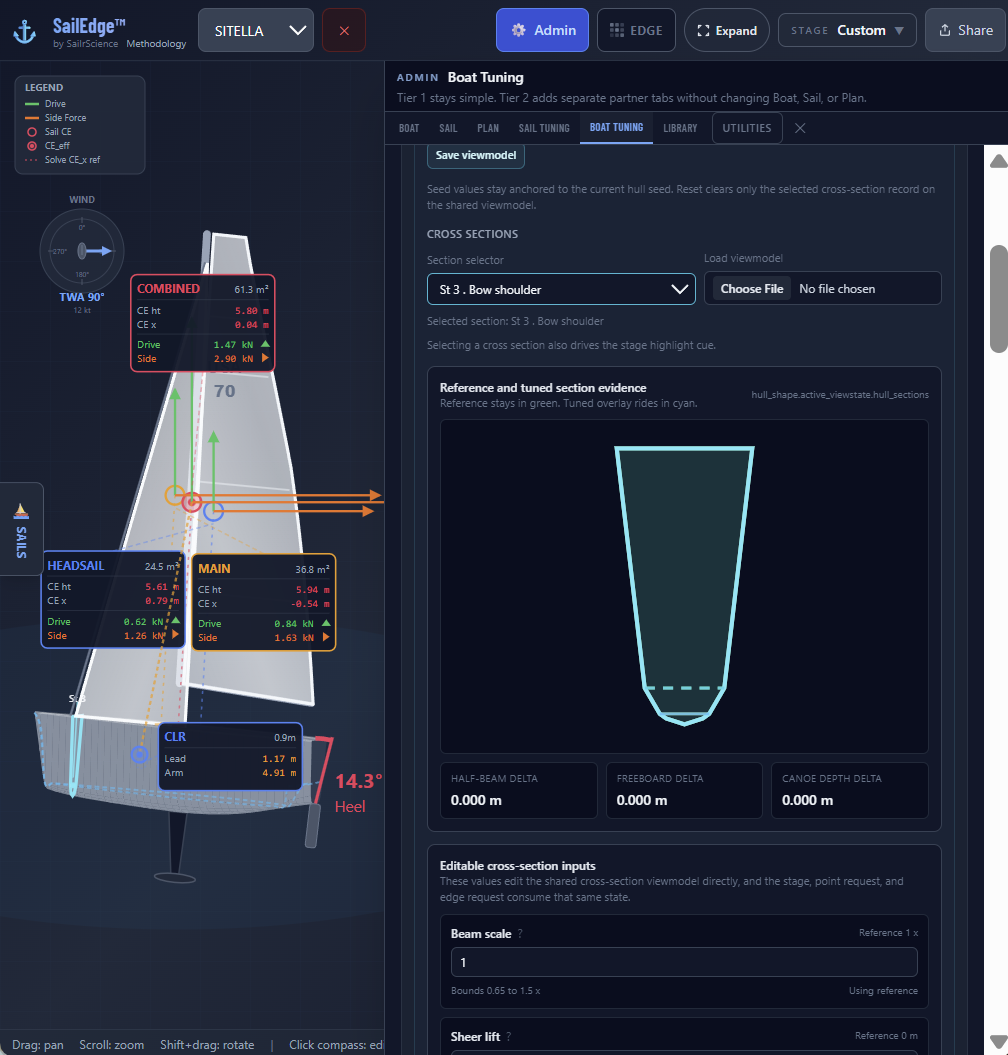
Select a station. Compare reference against tuned. Edit directly — Beam scale, Sheer lift, Rail lift, Keel drop.

The selected section highlights on the 3D stage. Save the hull-section viewmodel as a portable artifact. Reload it later from the same geometry basis.

SailEdge cross-section editor — St 3 bow-shoulder reference versus tuned section overlay with half-beam, freeboard, and canoe-depth deltas and the Beam scale control
Cross-section editor — reference vs. tuned

Hydro Authority

The Delft Series backbone is the authority.

The runtime resolves upright hull, appendage, heel influence, sideforce and leeway, keel-rudder interaction, and wave-added resistance through governed R14 hydro lanes. Each lane is individually tunable.

Every control carries always-visible help — what it does, what happens when you move it, when to adjust it.


Declared Rudder Geometry

Declare the rudder you actually built.

The rudder-geometry picker takes your declared blade — area, aspect ratio, the geometry on your drawings. The model uses your geometry, and only your geometry: declared data acts, undeclared stays byte-identical, nothing is invented. For the platforms you know best, the appendage story starts from what you built, not a library guess.


Portable Intent

Tune once. Save. Distribute.

Calibrate the class once — your profile is the foundation every sailmaker builds on. Portable, versioned, yours.

NA Tuning Profile

Bounded platform calibration. Load it on any boat. Sail lofts overlay their calibration on your foundation.

Hull Section Viewmodel

Cross-section editing state. Reload the same geometry basis without touching the canonical boat.

Boat JSON

Full study snapshot when the whole context must travel — boat, tuning, hull sections, and study state.

Licensing the foundation? SailrScience naval-architecture services — design validation, class calibration programs, and fleet benchmarking. Explore services →

Your platform. Your profile.

Calibrate the hull and hydro. Save the intent.

Talk to Us