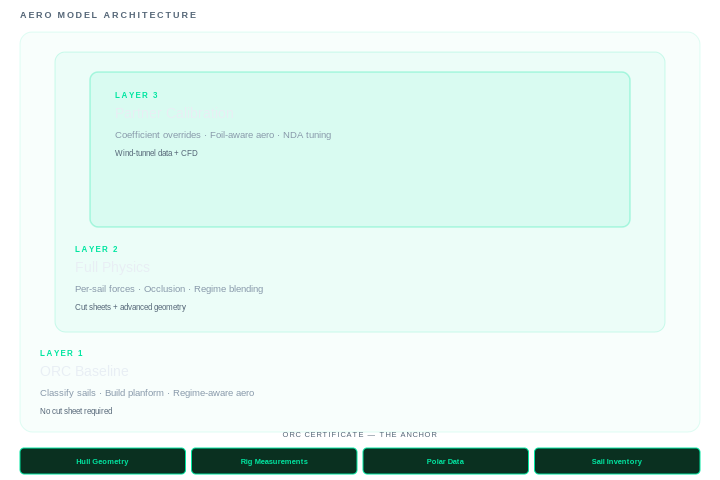
Shared Foundation
Every layer starts from the same anchor.
Regardless of layer, every computation starts from the same anchor: your ORC
certificate, its certified polar baseline, (the certificate’s polar performance grid — the official ORC speeds at each wind speed and angle that every Edge Map delta is measured against) and the same R16 boat runtime, with hull resistance on ORC’s published forms and DSYHS hull matching. Every delta is computed from
that certified baseline. Every output carries provenance tags showing where each
value came from. The model is stateless and deterministic — same inputs, same
outputs, every time.
What we publish: equations, pipeline, assumptions, provenance. What we don’t:
exact tuning coefficients, calibration data, or protected partner-specific model
parameters. The methodology is inspectable. The competitive advantage of our partners stays private.
The certificate supplies four categories of binding input: certified hull dimensions
and
rated stability (the boat’s righting behavior — rated on the certificate, then computed by the R16 stability layer for each sailing state), rig measurements,
polar performance data, and sail inventory dimensions. These are the
contract — immutable inputs that anchor every computation. Crew weight is a
separate analysis dimension — available at the
subscriber tier (the tier a SailEdge license unlocks — your own certificate and the physics it earns), no
Expert Mode required — and handled as a bounded
what-if, not a certificate override.