Your platform. Calibrated.
Boat Tuning in SailEdge™ by SailrScience — Delft-style stability, direct geometry editing, guided calibration, portable — now with the bowsprit design what-if.
Explore Your Edge NA Workflow →Boat Tuning in SailEdge™ by SailrScience — Delft-style stability, direct geometry editing, guided calibration, portable — now with the bowsprit design what-if.
Explore Your Edge NA Workflow →Tune the RM curve for form vs ballast.
Edit cross sections directly.
Calibrate the hydro lanes.
Portable NA profile and hull-section artifacts.
A stability profile built from GZ curve analysis — how much of the righting moment comes from hull form vs ballast, and how it evolves with heel.
Select a Delft hull on the Boat tab and the profile seeds automatically with the behavior your hull family predicts. Adjust for your specific hull.
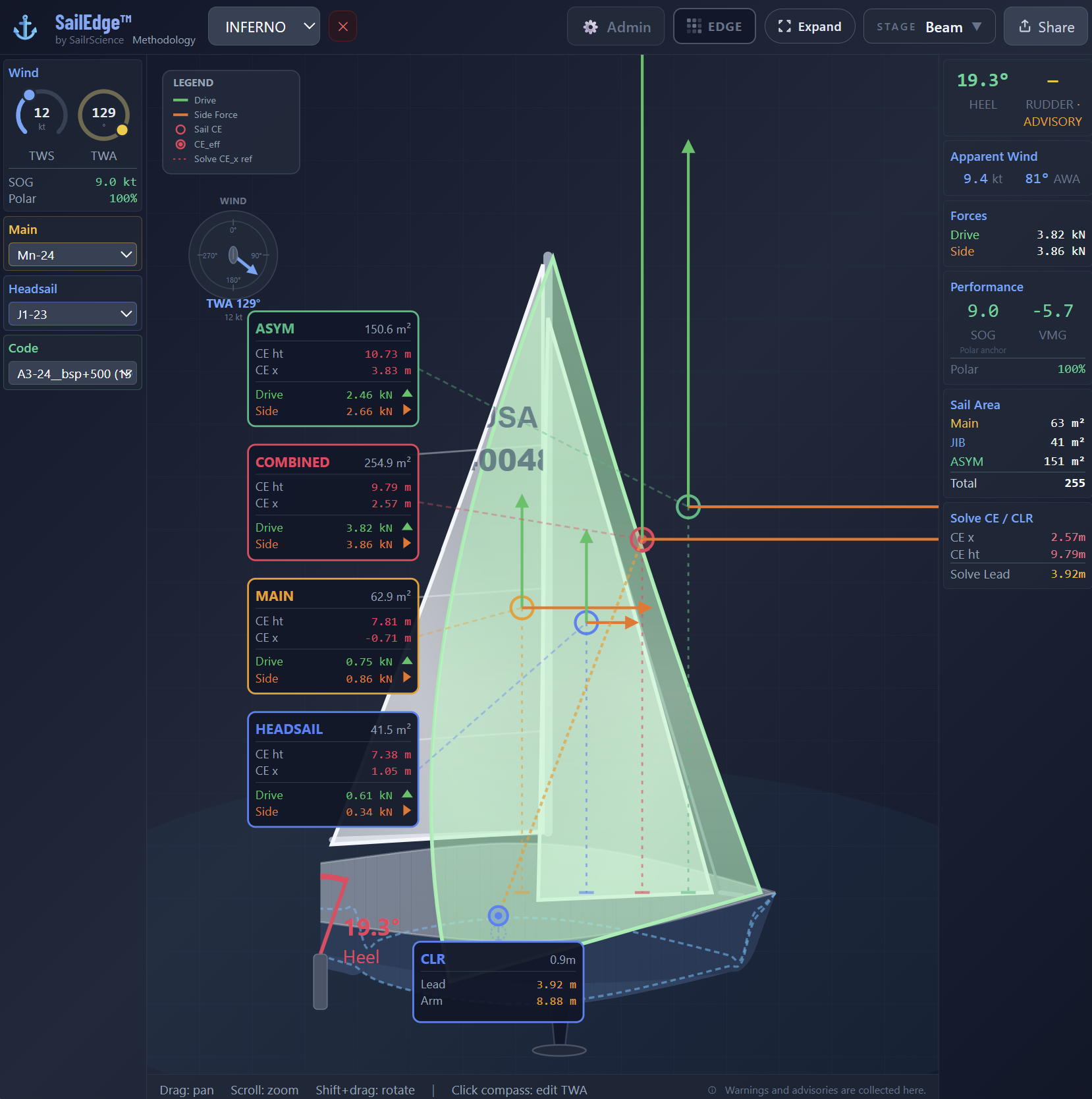
Righting moment is the third force in the balance story — see how it meets CE and CLR in the three-force system.
Stability behavior in R16 now comes with its sailing state attached. The same righting-moment foundation that anchors this section reports, at the boat’s ORC-rated target speed, whether she balances naturally, needs the modeled rig eased, or steps to a smaller rated sail to settle. For an owner tuning against a hull family, that context is the difference between a number and an answer.
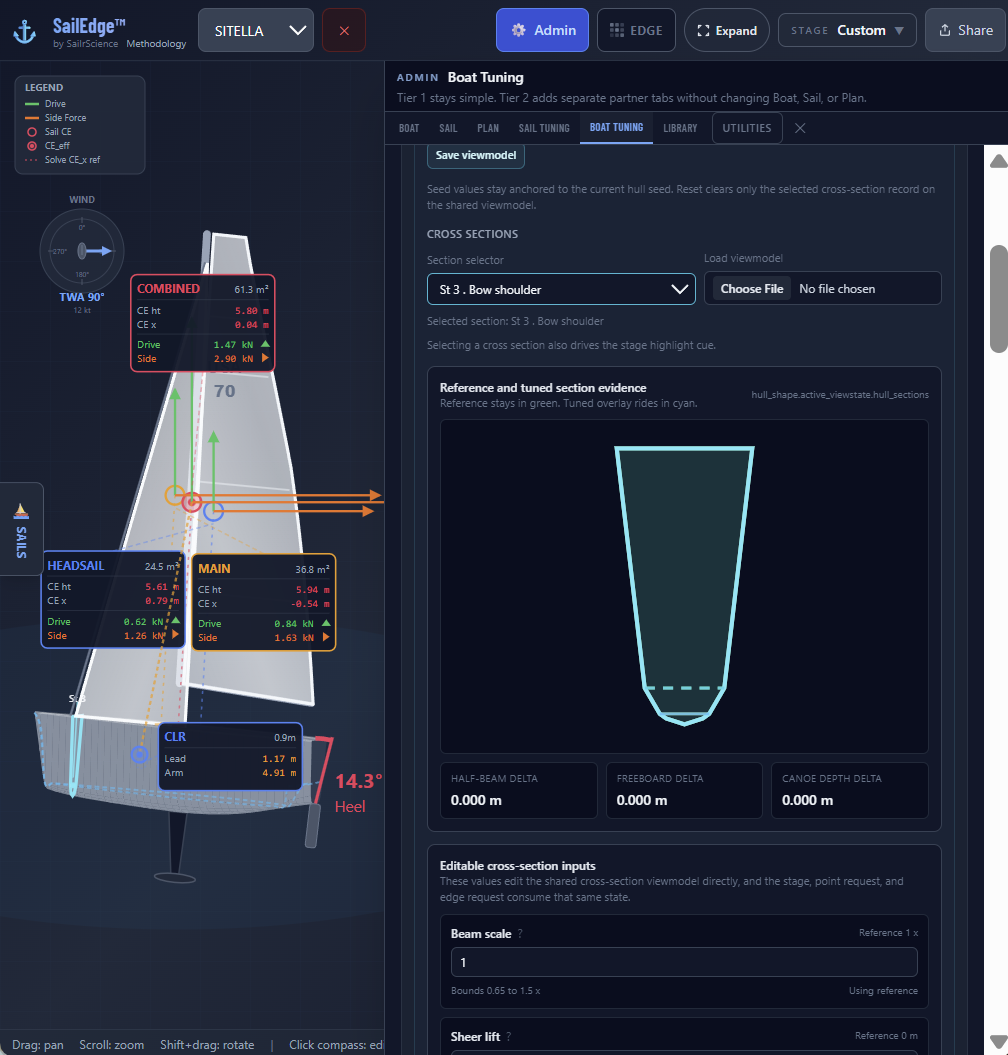
Select a station. Compare reference against tuned. Edit directly — Beam scale, Sheer lift, Rail lift, Keel drop.
The selected section highlights on the 3D stage. Save the hull-section viewmodel as a portable artifact. Reload it later from the same geometry basis.
The runtime resolves upright hull, appendage, heel influence, sideforce and leeway, keel-rudder interaction, and wave-added resistance through governed R16 hydro lanes. Each lane is individually tunable.
Every control carries always-visible help — what it does, what happens when you move it, when to adjust it.
The rudder-geometry picker takes your declared blade — area, aspect ratio, the geometry on your drawings. The model uses your geometry, and only your geometry: declared data acts, undeclared data stays untouched, nothing is invented. For the platforms you know best, the appendage story starts from what you built, not a library guess.
NA-grade work starts from a stability basis you can defend. R16.4 derives Certificate-Derived Righting Moment across the wind regimes — grounded in the boat’s own ORC certificate and the DSYHS hull library — so every what-if below rests on the platform’s own righting-moment foundation, not a class assumption.
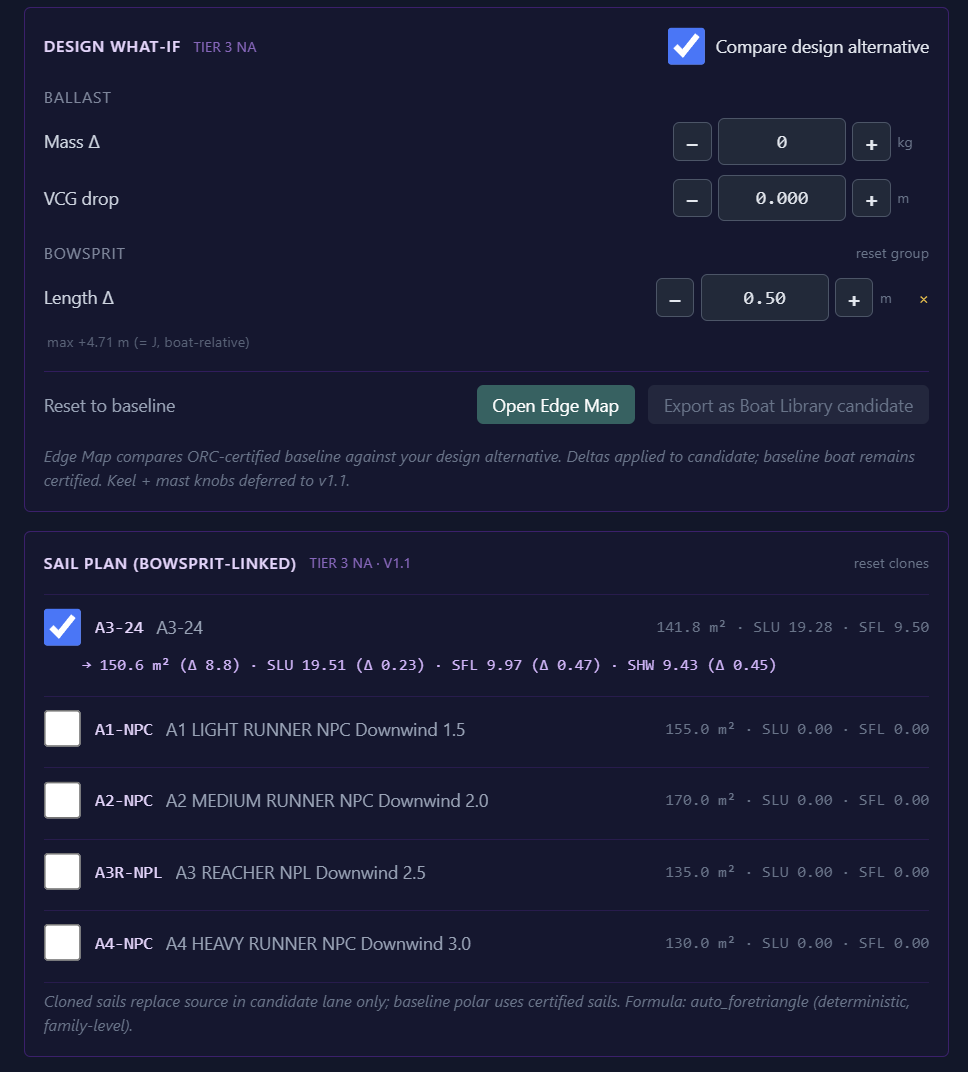
Then perturb one variable the way a design office would: extend the bowsprit. Set a length delta — bounded by the boat’s own J — and SailEdge scales the foretriangle geometry, derives the sprit-flown sail candidate (labeled as your what-if, never certificate data), moves the combined center of effort and the lead, and re-solves the candidate against the ORC-certified baseline. The Edge Map then shows where the sprit pays and where it costs, cell by cell, across the 9 TWS × 8 TWA matrix. Ballast deltas ride the same lane; keel and mast what-ifs are staged next (v1.1).
In naval architecture, a complete bowsprit perturbation study also answers the structural questions — spar buckling under compressive load, bobstay and attachment geometry, the rigging-load vectors. SailEdge models the aerodynamic and performance side. While not a complete perturbation study, this feature can be helpful to frame the potential benefit of a more complete study for the client before the work begins.
See the candidate’s full Edge Map study — where the sprit pays and where it costs — on Sail Studies.
Calibrate the class once — your profile is the foundation every sailmaker builds on. Portable, versioned, yours.
Bounded platform calibration. Load it on any boat. Sail lofts overlay their calibration on your foundation.
Cross-section editing state. Reload the same geometry basis without touching the canonical boat.
Full study snapshot when the whole context must travel — boat, tuning, hull sections, and study state.
Licensing the foundation? SailrScience naval-architecture services — design validation, class calibration programs, and fleet benchmarking. Explore services →