Your Hull Calibration. Every Sailmaker Builds On It.
Validate the live boat physics built on the R16 DSYHS calm-water backbone with bounded follow-on lanes. Save the profile. Sail lofts overlay their calibration on your foundation.
Two doors, one engine. Ready to calibrate? Talk to us → Evaluating an engagement? SailrScience naval-architecture services — design validation, fleet benchmarking, and custom performance-archetype analysis (archetypes: the fleet’s measured boat types). Explore services →
SailEdge runs a full force-balance computation (the solve that balances the aero and hydro forces at one wind condition — a SailEdge computation, never an ORC rating) at every point in the wind
matrix — the same discipline used by ORC and naval architecture firms. Your
role is to validate the boat side of that equation — now live on the R16 physics release — and save it as a calibration
that every sailmaker builds on.
From manual VPP harness to shared performance instrument.
Before SailEdge
Parse the ORC certificate with home-grown code
Stand up a VPP harness, configure hull and appendage inputs by hand
Run manual sweeps across conditions to isolate the performance domain
Present results in spreadsheets the client can’t interrogate
After SailEdge
Load the client’s ORC certificate — hull, rig, and stability (the boat’s righting behavior — rated on the certificate, then computed by the R16 stability layer for each sailing state) build in seconds
Discuss the problem together: high heel, a loaded helm, weak reaching drive
Use Boat Tuning’s design what-if to simulate before-and-after — the bowsprit as a perturbation study, plus ballast, rig, and stability changes
Agree on the remit from a shared view of the physics, not a pitch deck
1. Load the Hull
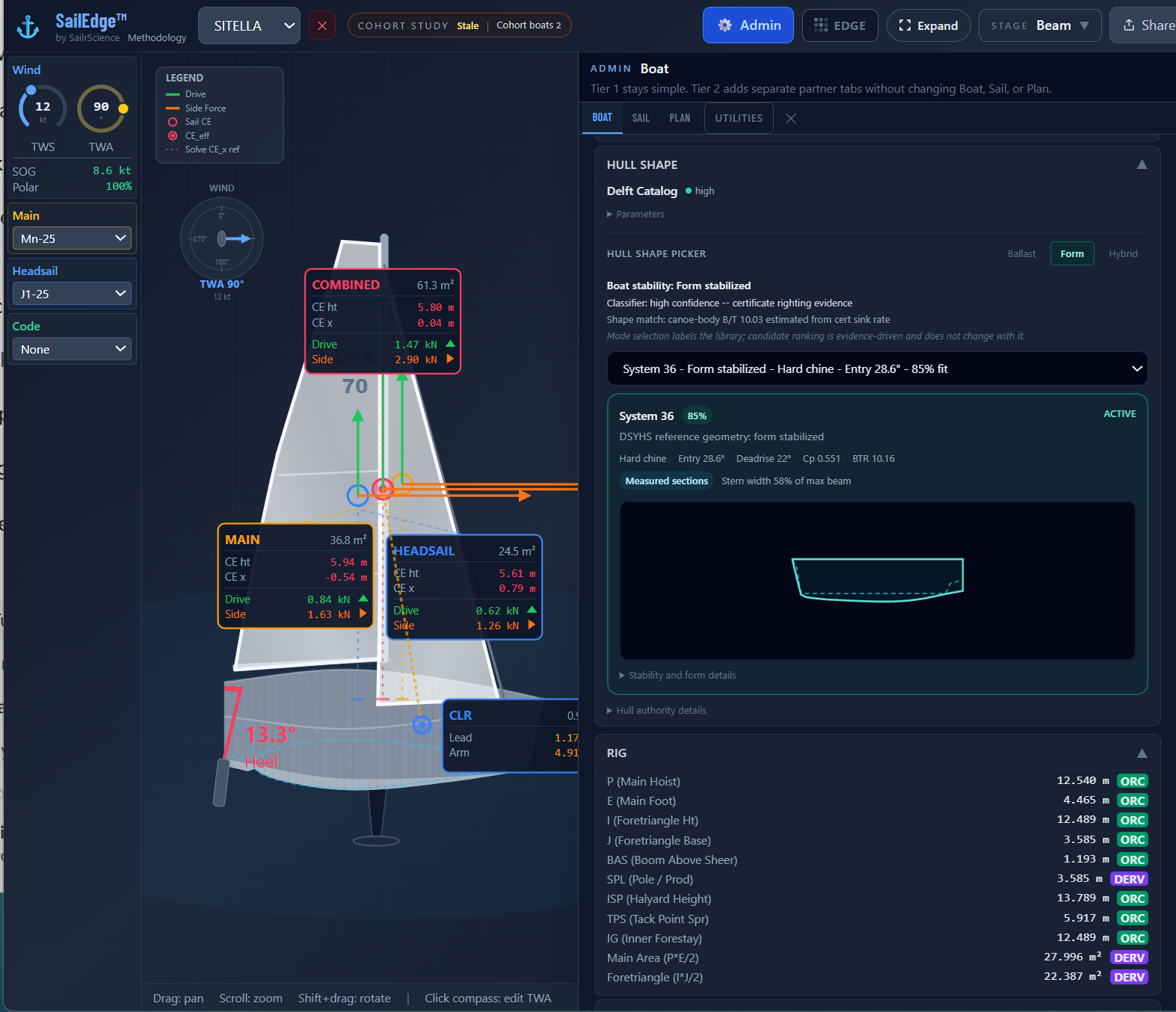
ORC certificate in, working boat model out. Displacement, stability, rig dimensions — verified against your design data.
2. Check the Boat Tab
Every parameter shows its source. ORC, Derived, Estimated — color-coded and traceable. Confirm it matches your numbers.
3. Inspect the Force Balance
Open point review or any Edge Map cell (one intersection of the wind matrix — one true wind angle, one true wind speed, one sail combination evaluated against the ORC polar). Drive, side force, heel moment, CE position, whole-boat outcome, and hydro-lane disclosure are all visible for any condition.
4. Confirm Across the Polar
One cell isn’t enough. Check upwind, reaching, downwind. When it converges across the range, the calibration is confirmed.
Step 1
Load and Inspect
Load the boat from its ORC certificate. Certified dimensions, stability data, polar
performance — everything the certificate provides. Review the measurements,
confirm they match your design data, and identify where the model needs refinement.
The righting moment curve is anchored to the certificate’s rated stability values
and drives heel equilibrium at every point of sail — its source and construction
are disclosed, never silently substituted.
Step 2
Evaluate the Force Balance
Open any Edge Map cell and inspect the force breakdown. Drive force, side force, heel
moment, Center of Effort position — the full picture of how the model resolves
that condition. Compare against your design data. Where the model diverges from known
behavior, you know where to tune.
The hull response layer now runs through the live R16 runtime backbone (DSYHS reference hulls): upright hull,
appendage, heel influence, sideforce/leeway, rudder interaction, and approved wave
resistance where the boat data supports it. Heel equilibrium is still solved
iteratively — the model finds the angle where heeling force from the sails
matches the boat’s righting moment, then reports exactly how much drive was
sacrificed if the rig depowered. These are the diagnostics you check against your
design data.
Boat Tuning now includes a Delft-style RM stability profile capturing how the
righting moment behaves as heel builds — form stability vs ballast stability.
It seeds automatically when you select a Delft hull family, then you adjust for
your specific hull. Every control explains what it does, what happens when you
move it, and when to adjust it.
Learn more →
The Hull Efficiency Index normalizes hull resistance across platforms — a single
metric that lets you compare drag characteristics across designs regardless of
displacement class.
Crew weight operates as a bounded what-if within the Edge Map (the performance delta grid — every sail measured against your boat’s ORC polar at every wind speed and angle). More weight means more
righting moment upwind but more displacement to drag downwind, so the sensitivity is
course-dependent. The certificate stays anchored. The what-if shows you where it
matters and where it doesn’t.
Step 3
Tune the Hull
Open Boat Tuning and review the bounded R16 runtime families first: upright hull,
heel influence, appendage, sideforce/leeway, and rudder interaction. Adjust those
before reaching for transitional residual overlays, and shape the hull physics until
the Edge Map converges with your design data across conditions.
Every adjustment recomputes immediately. The ORC baseline stays anchored.
Step 4
Confirm Across Conditions
One cell isn’t enough. Check the force balance across the polar — upwind,
reaching, downwind, light air, heavy air. When the model converges with your data across
the full range, the calibration is confirmed.
When a cell hits a physical constraint — hull speed cap, depower ceiling, or rudder
margin — the model flags it. Amber shading marks the cell and the detail card
identifies which constraint was active. That distinction matters: a divergence caused by
a model guardrail is different from a divergence caused by a calibration gap. One tells
you the model is protecting the result. The other tells you where to tune.
Ready to Calibrate
Hull shape selection, RM stability profiling, cross-section editing, and R16
hydro authority — the full calibration workspace for building your
platform foundation.
Every cell in the Edge Map contains 107 computed attributes. At the professional
tier (the tier Expert Mode opens — the deeper readout for those who want the full physics), you see roughly 65 of them — per-sail force attribution, CE geometry,
effective areas, confidence scoring, (the model’s own statement of how sure a cell is — an amber cell names the boundary that limits it) and clamp diagnostics. Engineering-grade access
under NDA surfaces the full set. The depth scales with the conversation —
but every tier solves the same physics. Tiers gate explainability, never physics.
Stability
Stability data you can put your name on
Competitor and cohort work has always stopped at the boats whose designers you
cannot call. R16 derives righting moment (RM) and heel behavior from the
certificate each boat already carries, publishes the confidence grade alongside
every value, and refuses outright where the evidence runs short. The grade and
the refusal are the defensibility: you always know which numbers will hold up.
Comparative work gains a dimension certificates alone leave implicit: sailing
state. Each boat in a study now reports whether its reference equilibrium is
natural, reached after modeled depower, reached after a modeled sail change
from the rated inventory, or honestly out of the modeled envelope — computed
from its own certificate on the principles ORC publishes. The rule is the same
as everywhere in R16: the result is graded for confidence, or refused with a
reason you can cite.
Reproducibility
Same inputs. Same result. Every time.
A validated calibration is only useful if it’s reproducible. Load the same
ORC certificate, apply the same boat tuning profile, specify the same conditions
— the Edge Map produces the same output. No drift. No randomness. No
“it depends on the run.”
That’s what makes the calibration auditable. You can hand it to a partner
loft, a class measurer, or a client — and they can verify the result
independently.
Step 5
Save and Distribute
Save your work as a Boat JSON artifact or NA tuning profile — your IP,
portable and independent. Send it to your loft partners. They overlay their sail
calibration on your validated hull physics. The result: every Edge Map for that
platform is built on a foundation you approved.
Your calibration plus their calibration. Neither works as well alone.
The peer proof is already in the water: Farr Design has adopted SailrScience
physics across their consulting workflow.
Step 6
Class-Wide Impact
Approve a class calibration and every owner in the fleet benefits. Lofts building on
your platform know the hull physics are validated. Owners shopping for sails see Edge
Maps built on builder-approved data.
Your work multiplies across the ecosystem. One calibration, every boat in the class,
every sailmaker who serves them.
Design Cohorts
From single hull to design family.
You’ve validated the hull. FleetEdge™ by SailrScience shows you the fleet:
11,207 boats analyzed within a 12,965-boat governed corpus, filterable by designer,
hull efficiency, or archetype. See how boats with similar geometry group together
— and where the outliers sit.
The eight archetypes (the 2026 census) each answer three questions: how the boat creates speed,
where that speed pays, and what it demands of the crew. The same DSYHS physics
that builds your Edge Map is what the archetypes are computed from. When a boat’s
archetype doesn’t match its hull family, that’s a question worth investigating.
All analytics are anchored to patent-pending force-balance physics.